Does Putting a Softball Glove in the Oven Actually Break It In Faster?
Quick Answer: Putting a glove in the oven can soften leather temporarily by relaxing its fibers, but it also risks drying out and permanently damaging the leather if heat is too high or too prolonged — safer, slower methods achieve genuine break-in without that risk.
It’s a tip that gets passed around dugouts constantly, but most people who’ve tried it also have a story about a glove that came out worse, not better.

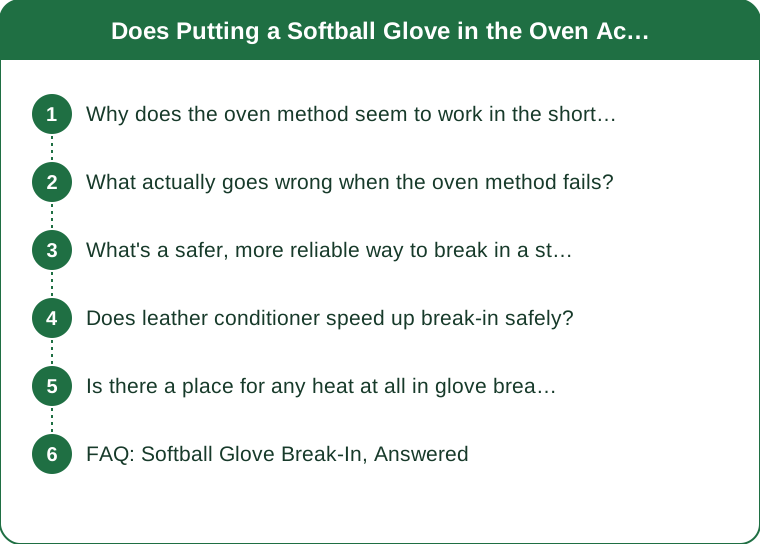
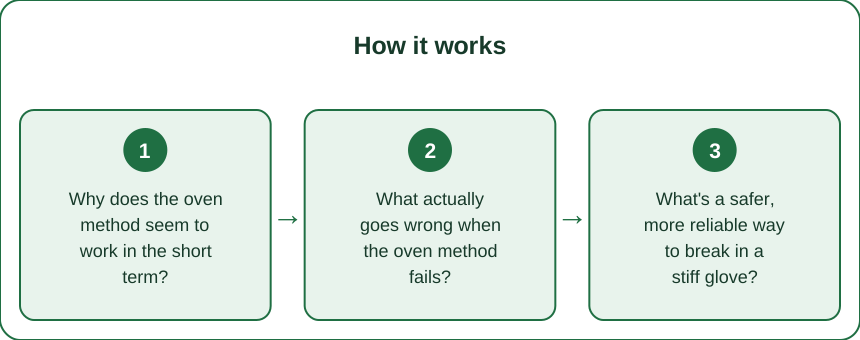
Why does the oven method seem to work in the short term?
Heat does temporarily relax leather fibers, making the material feel softer and more pliable immediately after warming, which is why the method has persisted as popular advice despite its risks. That softening effect is often temporary and comes with real downside risk, since leather can dry out, crack, or lose its natural oils if the heat is too high or applied for too long.
What actually goes wrong when the oven method fails?
Overheating strips natural oils from the leather, leaving it brittle and prone to cracking once it cools — damage that’s often not immediately obvious and shows up as premature wear weeks or months later, well after the oven session felt like a success in the moment.
What’s a safer, more reliable way to break in a stiff glove?
Repeated catching with a ball, combined with regular hand-working of the pocket and hinge points, breaks in leather gradually through the same natural flexing the glove will experience in actual use — this takes longer than an oven shortcut but shapes the glove specifically to its intended use pattern without risking leather damage.

Does leather conditioner speed up break-in safely?
Yes — a quality leather conditioner applied in moderation helps restore and maintain the natural oils that keep leather pliable, softening the material gradually without the drying risk that comes with direct heat exposure, making it a much safer accelerant than an oven.
Is there a place for any heat at all in glove break-in?
Some players use controlled, brief warmth (like leaving a glove in a warm car for a short period, not a hot oven) combined with hand-working, which carries meaningfully less risk than direct oven heat, though even this milder approach benefits from not overdoing duration or temperature.
FAQ: Softball Glove Break-In, Answered
How long does natural break-in typically take compared to the oven shortcut?
Natural break-in through regular use and conditioning often takes several weeks of consistent catching, versus the oven method’s near-instant but riskier softening.
Does wrapping a glove with a ball inside overnight actually help?
Yes — this shapes the pocket specifically around ball placement over time and is a low-risk, widely recommended technique that complements conditioner and regular use.
Is a stiff new glove actually a sign of quality leather?
Often yes — higher-quality leather tends to start stiffer and break in to a more durable, longer-lasting shape compared to pre-softened lower-quality leather that may wear out faster despite feeling better immediately.
TL;DR:
- The oven method temporarily softens leather but risks drying and cracking it
- Leather damage from overheating often isn’t obvious until weeks later
- Repeated catching plus hand-working the pocket breaks in a glove safely, just slower
- Quality leather conditioner softens leather without the drying risk of direct heat
- Wrapping a glove around a ball overnight is a low-risk way to help shape the pocket
The slower methods take more patience but don’t risk turning a good glove into a ruined one.
Keep Reading
This article is for general informational and styling purposes only. Fit, sizing, and product availability may vary.