Why Catching With Two Hands Fails More Often Than One in Real Play
Quick Answer: Two hands is correct when the ball is arriving in front of you at a comfortable height and you need to transfer quickly. It fails when you have to stretch, reach across your body, or move at full speed — because the second hand shortens your reach, restricts your shoulder and locks your body into a squarer position than the play allows. The real rule is not two hands or one; it is two hands when you can, one when you must, and knowing which is which.
The cue exists to solve a genuine problem.
It just gets taught as a law rather than as a situation.

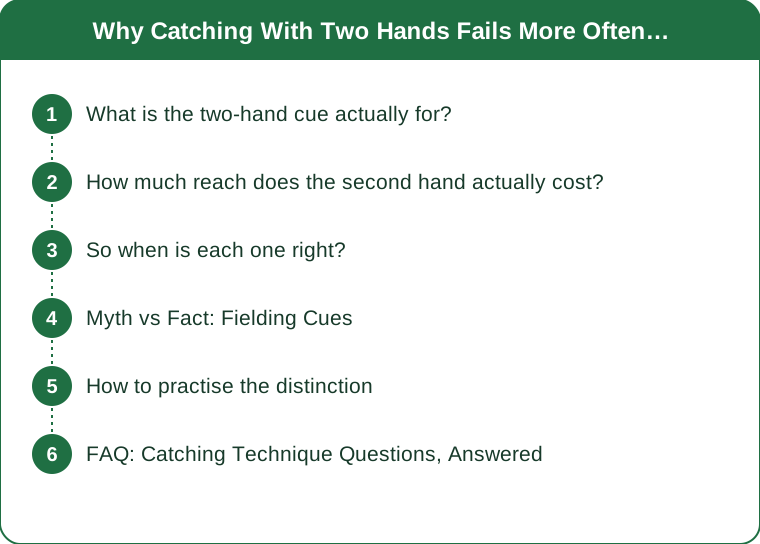
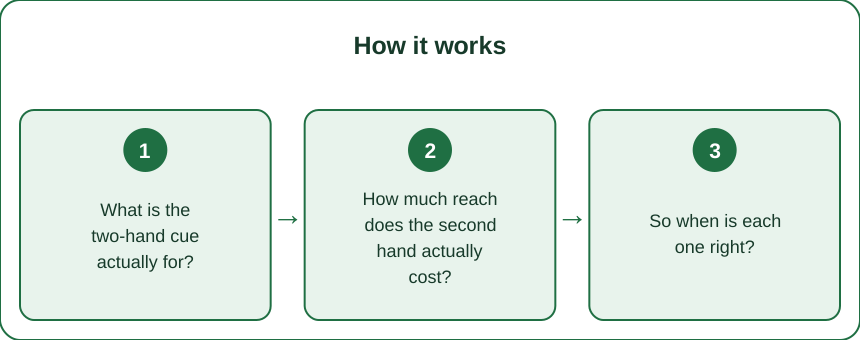
What is the two-hand cue actually for?
Two specific things, and neither is catching.
Transfer speed. The second hand is already at the glove when the ball arrives, so the exchange to the throwing hand happens immediately. On any play where you are throwing afterwards, this is worth a meaningful fraction of a second, which on a close play at first is the whole game.
Securing the catch. The bare hand closing over the ball reduces the chance of it popping out of the pocket, particularly on hard-hit balls and on the edges of the glove.
Notice that both benefits are about what happens after the ball hits the glove. Neither is about getting the glove to the ball.
That distinction is the whole issue. The two-hand cue optimises the second half of the play, and it does so by imposing a cost on the first half — reach and mobility.
When you have plenty of time and the ball is coming to you, that cost is zero and the benefit is real. Two hands is correct.
When the ball is at the edge of your range, the cost is the catch itself. And a fast transfer of a ball you did not catch is worth nothing.
How much reach does the second hand actually cost?
More than people estimate, and it is easy to demonstrate to yourself.
Stand up, put your glove hand out to your side at full stretch, and note where your fingertips land. Now bring your bare hand across to meet the glove and stretch again. The reach shortens substantially — typically by a foot or more depending on the direction, because bringing the second hand across rotates your shoulders and pulls the glove side back.
Three specific restrictions:
Lateral reach. Balls to your glove side are the clearest case. Any ball more than an arm’s length away is a one-handed play, and attempting two hands turns a routine catch into a dive.
Backhand plays. Balls across your body to the throwing-hand side are almost always one-handed by necessity. The second hand cannot get there, and trying to bring it means turning your body, which costs time you do not have.
High balls and running catches. Sprinting with both hands up in front of you is slower and less balanced than running with your arms free and raising the glove late. This is why outfielders run with their arms swinging and put the glove up in the final stride.
There is also a subtler cost: the second hand pulls your eyes and your body square to the ball, which is fine when the ball is in front and unhelpful when the play requires you to be moving through it.
So when is each one right?
A workable set of rules that covers nearly every play.
Use two hands when:
The ball is arriving in front of your body, roughly between your shoulders.
You are set or nearly set — feet under you, not at a full sprint.
You are going to throw immediately. Infield ground balls, routine fly balls with runners on, any force play.
The ball is hit hard and the priority is securing it.
Use one hand when:
The ball is outside your frame — anything requiring a stretch, a reach, or a step across.
You are running at speed and will catch on the move.
It is a backhand.
The ball is above your head and the reach matters more than the transfer.
You are making a diving or extended play, where any reduction in reach means not getting there.
The general principle: two hands is a completion habit, not a catching habit. Get the glove to the ball however you can, and bring the second hand in as the ball arrives if it is available.
A better cue than “two hands” is “glove first, hand follows.” It preserves the transfer benefit without limiting the reach, and it teaches the right sequence rather than a fixed position.

Myth vs Fact: Fielding Cues
Myth: One-handed catching is showing off.
Fact: Watch any level of competitive play and a large share of catches are one-handed, because a large share of balls are not hit conveniently in front of a fielder. The reputation comes from casual one-handed catches on easy balls, which is a different thing entirely.
Myth: Two hands prevents drops.
Fact: It reduces drops on balls you have already reached, and it increases misses on balls at the edge of your range. Which effect dominates depends entirely on where the ball is hit.
Myth: You should always get your body in front of the ball.
Fact: Excellent advice for beginners and for ground balls where blocking matters. Applied rigidly it costs range, because getting square to a ball you could have caught while moving through it wastes steps. Skill level decides which applies.
Myth: Alligator hands is the correct technique for everything.
Fact: It is a teaching device for young players learning to secure grounders in front of them. It has almost nothing to do with reaching a ball to your left at full stretch.
Myth: If you drop a one-handed catch, it proves the cue.
Fact: This is the reasoning that keeps the myth alive — a one-handed drop is visible and gets corrected, while the two-handed ball that fell in short of your reach looks like it was simply out of range and gets no comment at all. The failure mode of the cue is invisible, which is exactly why it persists.
How to practise the distinction
Four drills, because the goal is a decision that happens automatically rather than a technique you think about.
1. Range mapping. Have someone throw balls at increasing distance from you in a fan pattern, and catch each with two hands. Mark where you can no longer reach comfortably. That boundary is your two-hand zone, and knowing where it is means you stop trying to apply it outside.
2. Glove-first repetitions. Same throws, but consciously lead with the glove and bring the second hand in as the ball arrives rather than travelling with both hands together. This trains the sequence that gives you both reach and transfer speed.
3. One-handed only sessions. Ten minutes of catching everything one-handed, deliberately. Most players who were taught two hands rigidly have genuinely underdeveloped one-handed catching, because they have avoided practising it. It feels insecure at first and improves quickly.
4. Decision drills. Have a partner throw randomly — some in front, some wide, some backhand — and let the situation dictate. This is the only drill that trains the actual skill, which is choosing correctly in the fraction of a second available.
A note on the glove itself: a stiff or poorly broken-in glove makes one-handed catching much harder, because it will not close around the ball without help. If your one-handed catches are popping out, the glove may be the variable rather than your hands. A properly broken-in pocket does a substantial amount of the securing work by itself.
And as the season moves into colder weather, both leather and hands stiffen. Cold-weather catching genuinely is less secure, which is a reason to favour two hands where you have the option in late-season games — not because the technique changed, but because the margin did.
FAQ: Catching Technique Questions, Answered
Should I teach two hands to a beginner?
Yes, initially — it builds the transfer habit and secures the catch while the glove skill is developing. The important part is to teach it as a default for balls in front rather than as a universal rule, so it does not have to be unlearned later.
Does this apply to baseball too?
Identically. The physics of reach and the mechanics of transfer do not change with the ball size, though the larger softball is slightly harder to secure one-handed in a small pocket.
What about catching in the outfield specifically?
Outfielders run with arms free and raise the glove late, which is one-handed by necessity. On a routine fly ball with a runner tagging, bringing the second hand in as the ball arrives preserves the throw. Both apply in the same play.
Why do my one-handed catches pop out?
Usually the glove rather than the hand — an unbroken-in pocket or a web shape that does not suit how you catch. Sometimes it is catching with the glove too open, so the ball hits the heel rather than the pocket.
Is there a situation where two hands is genuinely wrong even on an easy ball?
On a high fly ball where you need to move under it late, running with both hands up costs balance and speed for no benefit. Run free, glove up at the end.
How do I stop a coach from correcting my one-handed catches?
Usually by demonstrating the reach difference rather than arguing about it. Most coaches who insist on the rule are applying a beginner cue out of habit, and the stretch test tends to settle it in about ten seconds.
TL;DR:
- The two-hand cue optimises transfer and security, not the act of reaching the ball
- The second hand shortens lateral reach substantially and restricts backhands and running catches
- Two hands for balls in front while set and throwing; one hand when stretching, sprinting or reaching across
- “Glove first, hand follows” is a better cue because it preserves both reach and transfer speed
- The failure mode of the rule is invisible, which is why it survives — a missed ball at full stretch looks out of range
Stand up and test your reach with one hand and then with two. The difference you will see in about five seconds is the whole argument, and it changes how you play the balls at the edge of your range.
Keep Reading
This article is for general informational and styling purposes only. Fit, sizing, and product availability may vary.