How to Keep Your Throwing Arm Healthy Across a Whole Season
Quick Answer: Track throwing volume, not just soreness. Most in-season arm problems come from accumulated throws with no planned light days, no proper warm-up progression, and no offseason strength base. The core routine is short and boring: a progressive throwing warm-up every time, a band and cuff routine after throwing rather than before, at least one genuinely light day per week, and a rule that you never throw hard when you are not warm. Sudden increases in volume are the pattern behind most flare-ups.
Your arm did not go on Tuesday.
It went across the previous three weeks, and Tuesday was just the day it told you.

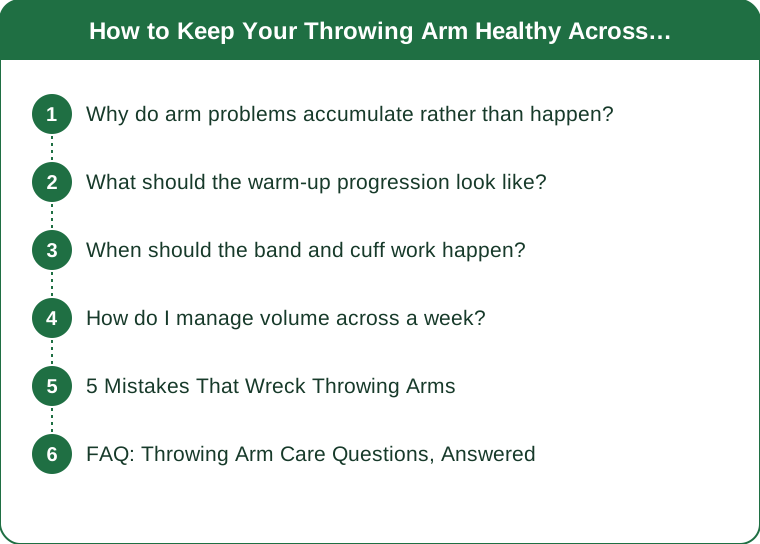
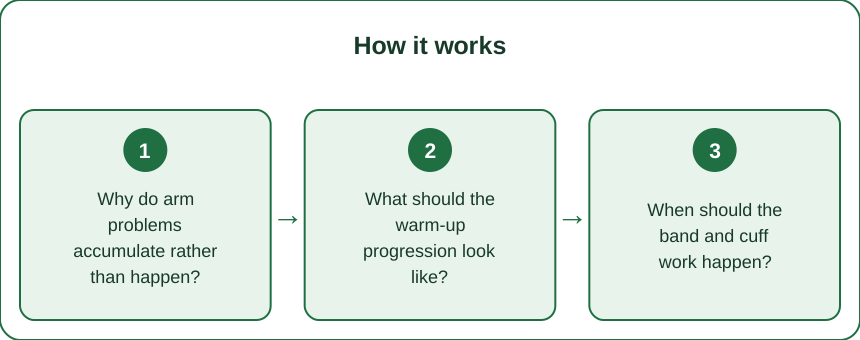
Why do arm problems accumulate rather than happen?
Throwing is a very high-velocity movement placing substantial stress on the shoulder and elbow, repeated many times per session.
Tissue adapts to load, but adaptation lags behind exposure, which means a sudden increase gets absorbed before it gets adapted to.
Research on throwing populations consistently links volume and workload spikes to injury risk, which is why pitch counts exist in the first place.
Fatigue changes mechanics, and altered mechanics under load is where a lot of damage is done - a tired arm throws differently, which is why late-practice throwing is disproportionately costly.
Recovery between sessions is where adaptation happens, and back-to-back heavy days remove it.
Which means the fix is scheduling, not toughness. This is general information, not medical advice.
What should the warm-up progression look like?
Raise general body temperature first, with two to three minutes of movement. Never start throwing cold - this is the most-broken rule in the sport.
Then arm circles and band work at low intensity to prepare the shoulder, not to fatigue it.
Then throw progressively: start close, short and light, and step back gradually. Ten to fifteen throws at each distance is typical.
Never skip distances. Going from a short warm-up straight to long throws is a common shortcut and a common route to a problem.
Build to intensity gradually within the session too. Full-effort throws belong after the arm is fully prepared, not in the first five minutes.
And extend all of this in cold weather. Autumn and early spring practices need a noticeably longer progression, and the arm takes longer to feel ready than it did in July.
When should the band and cuff work happen?
After throwing, generally, rather than before. Heavy band work before throwing can fatigue the small stabilising muscles you need during the session.
Light activation before is fine; volume work after is the usual structure.
External rotation, scapular work and posterior cuff exercises form the core of most arm care routines.
Keep it light and high repetition. This is not strength training in the traditional sense, it is capacity and control work.
Ten minutes, three to four times a week, is a realistic and effective volume.
And the offseason is when actual strength gets built - posterior chain, scapular strength, rotational core work and general upper body strength. In-season work maintains; it does not build. This is general information, not medical advice.

How do I manage volume across a week?
Count throws, at least roughly. Most players have no idea whether they threw 60 or 160 in a session, which makes managing volume impossible.
Plan at least one genuinely light day a week, and make light mean light rather than slightly less.
Avoid back-to-back heavy days, and treat a game and a full practice as both being heavy.
Watch for the pattern of sudden increases, such as a tournament weekend after a quiet fortnight - that is where problems cluster.
Reduce volume when tired, sore or unwell, rather than pushing through, since fatigue changes mechanics.
And build up gradually at the start of a season or after a break, rather than resuming at the volume you finished with.
5 Mistakes That Wreck Throwing Arms
1. Throwing hard when not fully warm. Almost everyone does this occasionally - a quick throw before practice starts, a warm-up throw at full effort. It is one of the highest-risk things in the sport and one of the easiest to stop.
2. Not counting throws. You cannot manage what you do not measure, and virtually nobody knows their weekly volume. A rough count in your phone is enough.
3. Heavy band work before throwing. Well intentioned and backwards - it fatigues the stabilisers you need most during the session. Light activation before, volume after.
4. Playing through soreness that changes your mechanics. General muscular soreness is normal; pain that makes you alter how you throw is a signal to stop. Altered mechanics under load is how a small problem becomes a large one.
5. No offseason strength work. In-season maintenance cannot build the capacity that gets you through a season. The base is built when you are not playing, and the players who skip it are the ones counting down to the end of the season by August.
And the bonus: ignoring the rest of the body. Throwing is a whole-body movement, and shoulder problems frequently come from poor hip mobility, weak legs or limited thoracic rotation. If your arm hurts, look at what is below it.
FAQ: Throwing Arm Care Questions, Answered
How many throws is too many?
It varies by position, age and conditioning, and governing bodies publish pitch count guidance for pitchers specifically. The more useful principle is avoiding sudden increases in your own weekly volume rather than hitting an absolute number.
Should I ice my arm after throwing?
Practice has shifted over time and the evidence is mixed. Many current approaches favour gentle movement and normal recovery over routine icing. Ask a qualified sports medicine professional about your situation.
Is soreness normal?
General muscular soreness after a heavy session is common. Sharp pain, pain inside the joint, pain that persists at rest, or any pain that changes how you throw is not, and should be assessed. This is general information, not medical advice.
When should the band routine happen?
Light activation before throwing, and the main volume after. Heavy band work beforehand fatigues exactly the muscles you need during the session.
Does long toss help or hurt?
It is widely used and can be valuable when progressed carefully. Like everything else, the risk is in sudden increases in distance or volume rather than in the activity itself.
What should I do in the offseason?
Build general strength - posterior chain, scapular strength, rotational core - and take a genuine break from throwing before ramping back up gradually. The offseason is where capacity is created.
When should I see a professional?
Pain inside the joint, pain that persists at rest or at night, numbness or tingling, loss of velocity with pain, or any sudden sharp event during a throw. Do not wait to see if it settles. This is general information, not medical advice.
TL;DR:
- Arm problems accumulate over weeks; the painful day is the end of the process, not the start.
- Never throw hard when not fully warm, and extend the warm-up in cold weather.
- Progressive throwing warm-up every time - do not skip distances.
- Light activation before throwing; band and cuff volume after.
- Count your throws roughly and plan at least one genuinely light day a week.
- Avoid sudden volume spikes, which is the pattern behind most flare-ups.
The routine is short and boring and it is the whole thing. This is general information, not medical advice.
Keep Reading
This article is for general informational and styling purposes only. Fit, sizing, and product availability may vary.