Why Late Summer Dew Ruins Infield Play Before the Sun Goes Down
Quick Answer: In late summer, dew starts forming on the infield 60-90 minutes before sunset, not after dark, because the ground cools faster than the air once the sun drops below the treeline. The result is a damp top layer over dry dirt — the ball skids instead of biting, and your glove leather stiffens. The fix is to change your fielding position depth and start charging earlier, not to change your hands.
Fifth inning. Nothing has changed. Same field, same light, same feet.
And suddenly two routine grounders have gone under your glove and a throw has sailed.
You did not get worse. The field did, and it happened about forty minutes ago while you were in the dugout.

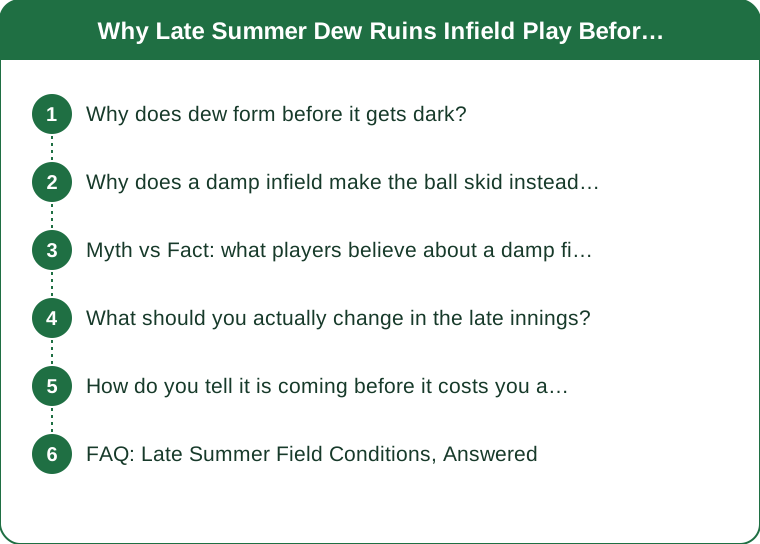
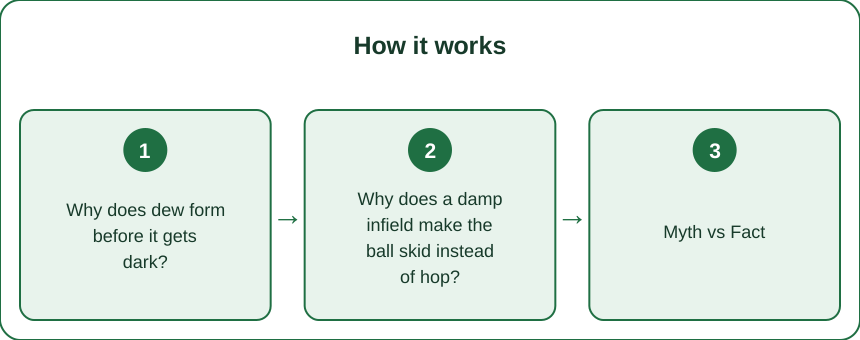
Why does dew form before it gets dark?
Because dew is about surface temperature, not clock time.
Dew forms when a surface cools to the dew point of the air around it. The infield dirt is exposed, thin and radiates heat quickly. Once direct sun leaves the field — which happens well before actual sunset if there are trees, stands or a treeline — the ground starts shedding heat fast.
The air above it stays warmer for longer. That gap is exactly the condition dew needs.
In late August this happens earlier than people expect for two reasons. Nights are already getting longer, so the sun is lower earlier in the evening. And late summer air often carries high humidity left over from the day’s heat, which raises the dew point and means less cooling is required.
So a 6pm game that was completely dry in early July can have a damp infield by the fifth inning at the end of August. Nothing about the day feels different. The physics shifted three weeks ago.
Grass shows it first, because blades cool faster than dirt. If the outfield grass has started to look darker or feel cool underfoot, the infield is roughly twenty minutes behind it.
Why does a damp infield make the ball skid instead of hop?
Because moisture sits on top of dry dirt and behaves like a lubricant, not like mud.
A properly wet field — after rain — is soft all the way through. The ball digs in, slows down and hops high. Every fielder knows how to play that.
Dew is different. It creates a thin slick film over a hard, dry base. The ball arrives, finds no friction on the surface and no give underneath, and it skids. It stays low and it keeps its speed.
That is the worst possible combination for a fielder, because your body has already predicted a hop that is not coming. Your glove goes to where the ball should be. The ball goes underneath it.
The second effect is on the seams. A slightly damp ball picks up less spin off the bat and less spin off your hand. Throws sail. This is the invisible half of the problem — players usually blame their mechanics when the throw goes high, but a wet seam has genuinely reduced the bite on the ball.
And the third: your glove leather stiffens as it cools and dampens. The pocket closes more slowly. A ball that would have stuck in the third inning pops out in the sixth.
Myth vs Fact: what players believe about a damp field
Myth: You can see dew before it affects play. Fact: By the time you can see it glistening, it has been changing ball behaviour for fifteen to twenty minutes. The reliable early sign is grass that feels cool rather than looks wet.
Myth: Charging the ball harder solves it. Fact: Charging helps, but only if you change when you commit. A skidding ball closes distance faster than you expect, so starting your move a beat earlier matters more than moving faster.
Myth: Wet conditions mean playing deeper for more reaction time. Fact: The opposite. Deeper means more time for the ball to stay low and skid past you. Move in two to three steps on a dewy infield.
Myth: Wiping your hand on your pants fixes a wet ball. Fact: It moves the water around. What actually helps is carrying dirt in your back pocket — a small amount of dry infield dirt to work into the seams before a throw.
Myth: It only affects infielders. Fact: Outfield grass gets slick sooner than infield dirt does. Late-inning outfield routes need shorter, choppier steps on the final approach — the last mistake players make is running through a cut that the grass will no longer hold.

What should you actually change in the late innings?
Five adjustments, in order of how much they matter.
1. Move in. Two to three steps for infielders. You are trading reaction time for the chance to take the ball before it skids past. On a dewy field that is a good trade.
2. Get lower earlier. Not deeper in your crouch at the moment of the ball — lower in your ready position before the pitch. You cannot drop fast enough to catch a skidder if you start upright.
3. Field with the glove on the ground. Set the glove flat on the dirt and come up to the ball if it hops, rather than coming down to it. A skidding ball punishes a glove that starts high; a hop is easy to adjust up to.
4. Dry the seams before every throw. Dirt from your back pocket, worked in with the thumb, takes two seconds. It is the difference between a throw that carries and one that sails.
5. Shorten your final steps in the outfield. Slick grass and a long final stride is how ankles turn. Choppy steps into the catch, always.
None of this is about trying harder. Effort is not the variable. The field changed, and the players who adjust their starting position are the ones who look unbothered in the seventh inning.
How do you tell it is coming before it costs you a play?
Build a habit of checking, rather than reacting.
The treeline test. Look at where the sun is relative to the tree line or stands, not where it is in the sky. Once direct sunlight has left the infield dirt, you have roughly twenty to thirty minutes before ball behaviour starts changing.
The glove test. Between innings, press your bare hand flat into the pocket of your glove. If the leather feels cooler than your hand rather than neutral, the air is dropping and dew is near.
The grass test. Walk on the outfield grass on your way in. Cool underfoot means it is starting. Visibly damp means it started a while ago.
The infield dirt test. Scuff the dirt in front of you with a cleat. If the top skim comes up darker than the layer beneath it, you already have the slick-over-dry combination.
Do these between innings and you get a warning instead of a surprise. The players who look like they read the ball better usually just checked the field earlier.
FAQ: Late Summer Field Conditions, Answered
Should I change gloves for a damp game?
No — but keep your glove in your bag rather than on the ground between innings. Leather on cool damp dirt stiffens noticeably faster than leather in a bag.
Does dew affect hitting as well as fielding?
Slightly. A damp ball comes off the bat marginally slower, and the batter’s box gets slick before the infield does. Check your back foot for slipping in the late innings before you blame your swing.
Why is it worse in late August than in June?
Longer nights mean earlier loss of direct sun, and late-summer air holds more residual humidity from the day. Both raise the chance of dew forming while the game is still going. In June the same field would stay dry until well after the final out.
TL;DR:
- Dew forms 60-90 minutes before sunset in late summer because the ground cools faster than the air.
- It creates a slick film over dry dirt, so grounders skid low and fast instead of hopping.
- Move in two to three steps, get lower earlier, and set your glove on the ground.
- Dry the seams with pocket dirt before throws, and shorten your final steps in the outfield.
The thing to take from this is that late-inning errors on a clear evening are usually not a concentration problem. The surface genuinely changed while you were sitting in the dugout, and the players who look unflappable in the seventh are the ones who checked the grass on their way in. Do the treeline check once an inning from the fourth onward, and the field stops surprising you.
Keep Reading
This article is for general informational and styling purposes only. Fit, sizing, and product availability may vary.