Why a Cold Softball Feels Like Hitting a Rock - and What to Change
Quick Answer: Cold reduces the ball’s compression and the bat’s trampoline effect at the same time, so the same swing produces less exit speed and more vibration back into your hands. Expect meaningfully less distance in the cold. Keep balls warm before use, choose a bat rated for cold, hit slightly further out on the barrel, and wear batting gloves - the sting is mostly a temperature problem, not a technique one.
First cold game of the fall and you catch one clean and it goes nowhere. Then you catch one off the end and your hands ring for a full minute.
You did not forget how to hit in three weeks.
Both the ball and the bat are behaving differently at 45F than they did at 80F, and the effects stack in the same direction.

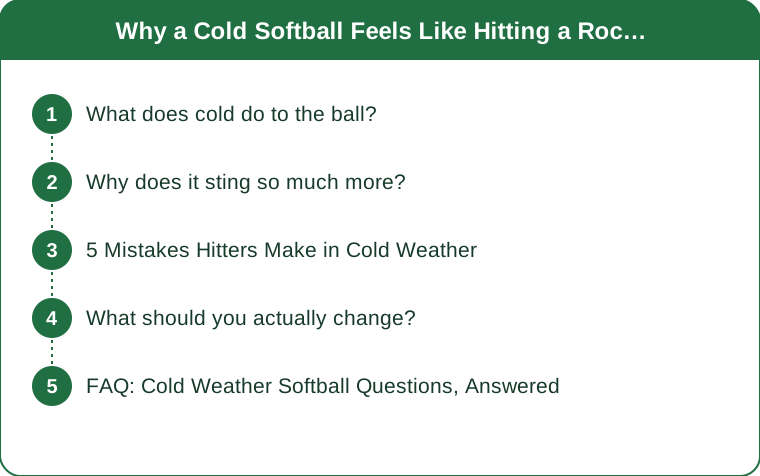
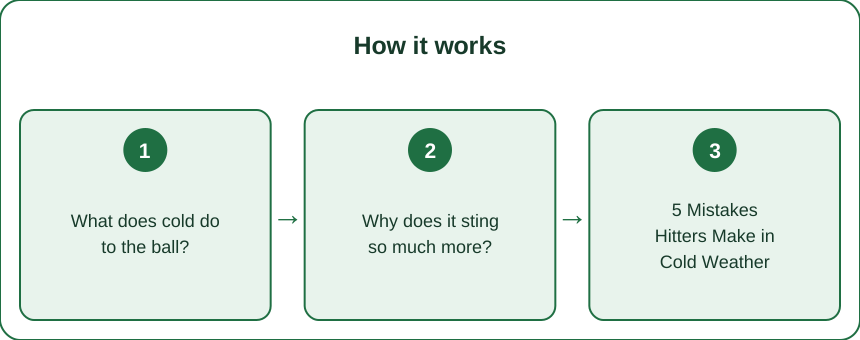
What does cold do to the ball?
It stiffens it, and a stiffer ball returns less energy.
A softball is built around a core - usually polyurethane - inside a wound and covered shell. That core is designed to compress on impact and spring back, and the springing back is where a large part of exit velocity comes from.
Cold makes the core material harder and less elastic. It compresses less on impact and returns less of the energy it does absorb. Ball compression ratings are measured at controlled room temperature precisely because they change so much with it.
The practical result is that a ball at around 40 to 50F behaves like a substantially higher-compression ball. It feels harder in the hand, it feels harder off the bat, and it comes off the bat slower for the same swing.
A commonly cited working figure is a few feet of carry lost for every ten degrees the temperature drops, and cold air being denser adds a little more drag on top. Between the two, a ball that carried to the fence in July may land well short of the warning track in October off an identical swing.
The less obvious consequence is that the energy that does not go into the ball has to go somewhere, and where it goes is back up the bat into your hands.
Why does it sting so much more?
Because both halves of the collision got stiffer, and vibration is what stiffness produces.
A composite or alloy bat has a designed flex - the barrel compresses slightly on contact and springs back, adding energy to the ball. That is the trampoline effect, and it is a real and significant part of how modern bats perform.
Composite materials get stiffer in the cold. The barrel flexes less, which reduces the trampoline effect and simultaneously means more of the impact energy converts into vibration travelling down the handle.
Hit anywhere near the sweet spot and vibration is minimal regardless. Miss it by a couple of inches on a warm day and you get a mild buzz. Miss it by the same amount on a cold day and it genuinely hurts, because there is more vibration and your hands are also colder and less able to damp it.
Cold hands matter more than people credit. Blood flow to the extremities drops in the cold, tissue is less compliant, and nerve response changes. The same vibration through cold hands is a much worse experience than through warm ones.
And this is where the real risk sits, which is to the bat rather than to you. Composite bats are prone to cracking in the cold, which is why most manufacturers specify a minimum temperature - commonly around 50 to 60F - below which the warranty does not apply. Using a composite bat in genuinely cold weather is a good way to destroy an expensive bat.

5 Mistakes Hitters Make in Cold Weather
1. Swinging harder to compensate. The most natural response and the most counterproductive. Exit velocity is lost to physics, not to effort, and swinging harder mainly degrades timing and increases mis-hits - which is exactly what produces the sting. Swing the same and accept the shorter distance.
2. Using a composite bat below its rated temperature. Cracks a bat that costs more than a whole season of gloves. Keep an alloy bat in the bag for cold games; alloy is far less temperature-sensitive and much cheaper to replace.
3. Leaving the game balls in the car overnight. A bag of balls that has been at 35F all night is significantly harder than one kept indoors. Bring them in the house, and on cold days keep the ones you are using in a warm bag between innings.
4. Skipping batting gloves because they feel bulky. Gloves reduce transmitted vibration meaningfully and keep hands warm enough to damp what does come through. In cold weather they are not a preference, they are equipment.
5. Warming up the same way as in July. Cold muscle and tendon take longer to become compliant, and the first hard swing of a cold day is a common point of injury. Twice the warm-up time, progressive intensity, and no maximum-effort swing until you are genuinely loose.
What should you actually change?
Some of this is equipment and some of it is approach.
Keep the balls warm. The single most effective change available and the cheapest. Balls stored indoors, a warm bag in the dugout, and rotating balls in and out of it. A warm ball plays close to normal.
Switch to an alloy bat for cold games. No temperature restriction in practice, far less risk of cracking, and less loss of performance in the cold than composite. Many players keep a cheaper alloy bat specifically for fall and early spring.
Hit slightly further in on the barrel than you would in summer. The effective sweet spot shifts marginally toward the handle as the barrel stiffens, and hitting a fraction further in reduces sting for very little loss of performance.
Choke up a little. A shorter effective lever means less vibration reaching your hands and better bat control in conditions where timing is already harder. The distance you lose is small compared with what the cold already took.
Wear a thin base layer under the jersey and keep the hands warm between at-bats. Hand warmers in the pockets are common at higher levels for a reason.
Adjust expectations on approach. Fewer balls will carry, so the deep fly that was a home run in July is an out in October. Hitting line drives and using the whole field is a better cold-weather approach than trying to lift the ball, and it is what good cold-weather hitters converge on.
And if your hands are stinging on well-struck balls rather than mis-hits, or the pain persists after the game, that is worth getting looked at rather than working through. This is general information, not medical advice.
FAQ: Cold Weather Softball Questions, Answered
At what temperature should I stop using my composite bat?
Check the manufacturer’s specification, which is usually printed or on their site. Common thresholds sit somewhere between 50 and 60F. Below that, the warranty typically does not cover cracking, which tells you what they expect to happen.
Does the ball actually get harder or does it just feel harder?
It genuinely gets harder. Compression increases measurably as temperature drops, which is why compression ratings are specified at a controlled temperature in the first place.
Do pitchers have to change anything?
Yes. Grip is harder on a cold, hard ball and spin is more difficult to impart, so movement pitches lose some bite. Keeping the hand warm between pitches matters more than any mechanical adjustment, and a longer arm warm-up is essential.
Is fielding affected too?
Noticeably. A cold ball comes off the bat with less speed but hits the glove harder and stings more, and gloves themselves stiffen in the cold. Working the glove before the game and keeping it warm both help.
TL;DR:
- Cold stiffens the ball’s core and the bat’s barrel at once, so you lose exit speed and gain vibration.
- Expect meaningfully less carry as the temperature drops, and do not try to swing it back.
- Keep game balls warm, switch to alloy for cold games, and check your composite bat’s minimum temperature.
- Wear batting gloves, choke up slightly, hit a fraction further in on the barrel, and double the warm-up.
The rock-hard feeling on a cold afternoon is a real change in the equipment, not a change in you - and almost all of it can be managed with a warm bag of balls and a different bat.
Keep Reading
This article is for general informational and styling purposes only. Fit, sizing, and product availability may vary.