How You Store Your Glove Over the Off-Season Decides Next Spring's Break-In
Quick Answer: Leather loses moisture in dry indoor winter air and hardens, and a glove stored without a ball in the pocket loses the shape it took two seasons to develop. The two changes that matter most are storing it with a ball tied into the pocket and keeping it out of heated, dry spaces — not more conditioner. Over-oiling a stored glove causes more damage than under-oiling it.
You spent two summers getting that glove exactly right. Then you put it in a bag in the garage in October and spent April wondering why it feels like a new one.

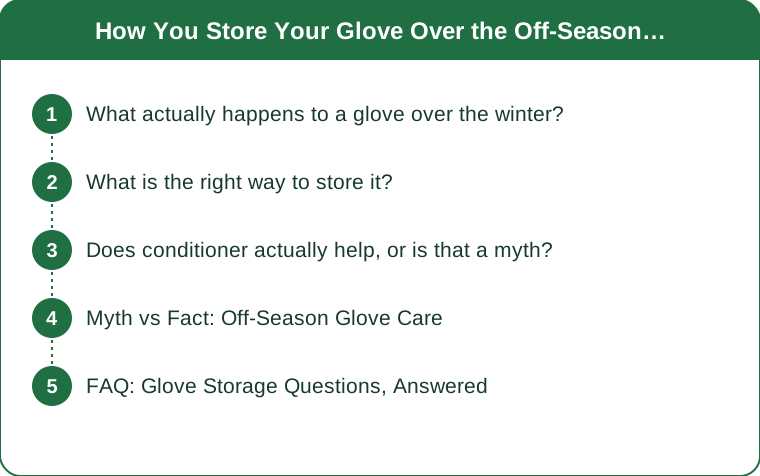
What actually happens to a glove over the winter?
Two separate degradations, and they have different causes.
Leather dries out. Heated indoor air in winter frequently runs below 30% relative humidity, sometimes much lower. Leather is hygroscopic — it exchanges moisture with the air around it — and at low humidity it loses moisture from its fibers, which stiffens and eventually cracks it. This is why a glove stored inside a heated house can end up stiffer than one stored in an unheated shed, which is the opposite of what most people assume.
The pocket collapses. The pocket shape is a physical deformation of the leather that you created through hundreds of catches. Leather has memory but it isn’t permanent — stored flat and empty, the pocket gradually relaxes toward flatter. Six months is more than enough to lose a meaningful amount of it.
A third, less common problem is mildew. A damp glove sealed in a bag grows mold, which stains the leather and produces a smell that’s very difficult to remove. This is the failure mode of putting a glove away straight after the last wet game.
The timeline
Most of the drying happens in the first six to eight weeks once heating season starts. A glove checked in February is often already past the point where simple conditioning restores it, which is why the storage decision in October matters far more than anything you do in March.
What is the right way to store it?
Four steps, and the whole thing takes about ten minutes at the end of the season.
1. Clean it first, and let it dry fully. Wipe dirt off with a barely damp cloth, then let it air dry at room temperature for a day. Never near a heater, in direct sun, or in a car — rapid drying is what cracks leather. A glove that goes into storage damp is the mildew case.
2. Condition lightly — and lightly is the operative word. A thin coat of a leather conditioner made for gloves, worked in with your fingers and wiped back. Over-conditioning is a real and common mistake: excess oil soaks into the leather, adds weight, softens the structure past the point of usefulness, and can rot the laces over time. If the glove looks oily after ten minutes, you used too much.
3. Put a ball in the pocket and tie it closed. This is the step that preserves the shape you spent two seasons building. A ball in the pocket with the glove wrapped around it and secured with a glove strap, a belt, or a couple of rubber bands maintains the pocket depth. Don’t over-tighten to the point of creasing the leather.
4. Store it somewhere with stable, moderate humidity. A closet in the living space is better than an attic or garage. Avoid basements if they’re damp, avoid attics because of heat cycling, and avoid the trunk of a car entirely — temperature swings there are extreme.
What not to do
Don’t seal it in a plastic bag. Leather needs air exchange, and a sealed bag traps whatever moisture is in the glove. A breathable cloth bag or no bag at all is better.

Does conditioner actually help, or is that a myth?
It helps, but far less than the internet suggests, and the popular products cause real damage.
What conditioner does: replaces some of the oils that keep leather fibers flexible. Applied thinly a couple of times a year, it genuinely extends glove life.
What it doesn’t do: break a glove in, restore a collapsed pocket, or fix leather that’s already cracked. People apply conditioner expecting a structural result and get a cosmetic one.
The damaging products are the household oils people reach for. Petroleum jelly, mink oil in quantity, olive oil, and neatsfoot oil applied heavily all over-soften leather and add weight. Olive oil in particular can go rancid inside the leather, which is exactly the smell problem it sounds like. Shaving cream, a longstanding piece of folk advice, contains stearic acid and works as a mild conditioner — but it’s an inferior version of a product that costs a few dollars.
The right amount is startlingly small. A dime-sized amount for a whole glove, worked into the palm and the areas that flex, then wiped back. Twice a year is plenty for most gloves — end of season and start of season.
Laces need attention more than the leather does. Check every lace at the end of the season and replace any that are fraying. A lace that breaks in March costs you the first weeks of the season, and relacing a glove is far easier when it’s clean and dry than when it’s mid-season.
Myth vs Fact: Off-Season Glove Care
Myth: Storing a glove somewhere warm keeps the leather supple. Fact: Warm air is dry air in winter. Heat plus low humidity is the exact combination that hardens leather, and a heated attic or a spot near a radiator is among the worst places available.
Myth: More conditioner means better protection. Fact: Excess oil over-softens the leather, adds weight, and degrades laces. A dime-sized amount twice a year outperforms a heavy annual soak.
Myth: The pocket shape is permanent once broken in. Fact: Leather memory relaxes over months. Storing with a ball tied into the pocket is the difference between resuming in April and re-breaking-in through May.
Myth: A plastic bag protects it from dust and moisture. Fact: It traps moisture against the leather and prevents air exchange, which invites mildew. Breathable storage is better in every case.
Myth: If it’s stiff in spring, just play through it. Fact: Stiff leather at the first practices is when laces break and when catching form compensates badly. Two weeks of gentle work before the season starts costs far less than a month of bad catches.
FAQ: Glove Storage Questions, Answered
Where’s the best place in a house to store a glove?
An interior closet at living-space temperature and humidity. Away from vents, exterior walls, attics, garages, and car trunks.
Should I use a glove mallet before storing?
Not necessary for storage. Save the mallet work for the pre-season, when you’re waking the leather up.
How do I know if I’ve over-conditioned?
The glove feels heavier, the leather looks darkened and slightly greasy after a day, and the pocket feels floppy rather than structured.
What about a glove that’s already gone stiff over a previous winter?
Gentle conditioning plus catching work usually recovers most of it. Cracked leather is permanent, but stiff leather generally isn’t.
Do synthetic gloves need any of this?
Much less. They don’t dry out the same way, but the pocket still benefits from being stored with a ball in it.
When should I do the end-of-season care?
Within a couple of weeks of the last game, before heating season starts drying the air out.
TL;DR:
- Winter indoor air is very dry, and heated storage hardens leather faster than cold storage does
- Store with a ball tied into the pocket — leather memory relaxes over six months
- Condition thinly and twice a year; over-oiling softens structure and rots laces
- Skip petroleum jelly, olive oil, and heavy mink oil entirely
- Clean and fully dry before storing, never in a sealed plastic bag
- Check and replace fraying laces now, not in March
Ten minutes in October is worth six weeks in April. The break-in you’re protecting already cost you two seasons.
Keep Reading
This article is for general informational and styling purposes only. Fit, sizing, and product availability may vary.