Should You Choke Up on the Bat?
Quick Answer: Choke up when bat control matters more than distance — with two strikes, against high velocity, or any time you are consistently late. Moving your hands an inch or two up the handle shortens the effective lever, which measurably increases bat speed and shortens your swing, at the cost of a modest reduction in power on contact. For most recreational hitters the control gain outweighs the power loss far more often than they assume.
Somebody told you at 12 that choking up means you cannot handle your bat, and you have not done it since.
The physics disagree. Choking up is a trade between two things, and most hitters badly misjudge which side of that trade they are on — the specific situation in the third section is where it converts more outs into contact than any other adjustment available to you.

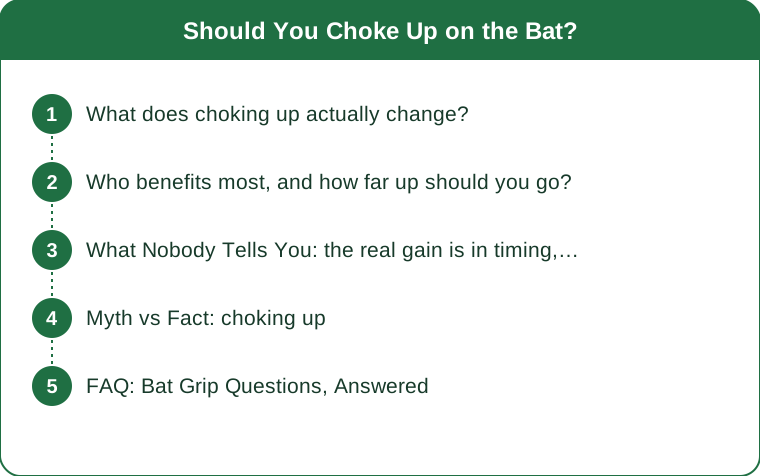
What does choking up actually change?
It shortens the lever. That single change cascades.
A bat rotating around your hands behaves like any rotating object: the further the barrel is from your grip, the more resistance it has to being accelerated. Move your hands up the handle and you reduce that resistance, which means you can get the barrel to the ball faster and start the swing later.
The measurable effects:
Swing gets quicker. Not necessarily faster barrel speed at contact, but a shorter time from decision to contact — which is what actually matters when you are late on a pitch.
Bat control improves. Less mass swinging further out means more ability to adjust mid-swing, which is why choking up helps against off-speed and breaking pitches.
Power on contact decreases somewhat. A shorter effective lever means less barrel velocity at maximum, so well-struck balls travel less far. The reduction is real but usually smaller than hitters fear — commonly a few percent, not a transformation.
The trade in one line: you give up some distance on your best contact in exchange for making contact more often and more squarely. For a hitter who strikes out or gets jammed regularly, that is an obviously good deal.
Who benefits most, and how far up should you go?
The situations where it clearly helps
Two strikes. This is the standard use and it is standard for good reason. With two strikes your job changes from driving the ball to putting it in play, and a shorter, quicker swing does that better. Even hitters who never choke up otherwise should consider it here.
You are consistently late. If you are fouling pitches off to the opposite side, or the ball is getting past you on the inner half, your swing is too slow for the velocity you are facing. Choking up is the fastest fix available and requires no mechanical change.
Your bat is too heavy for you. Very common in recreational play, where people use whatever is in the bag. If you cannot control the barrel through the zone, choking up simulates a lighter bat instantly.
Against a hard thrower, particularly in the first at-bat before you have timed them.
How far?
Start with one inch. That is enough to feel different without changing your swing plane. Two inches is a meaningful adjustment used with two strikes or against real velocity. Beyond about three inches you are far enough down the taper that the balance changes noticeably and you may be better served by a lighter bat.
Keep the knob against the heel of your bottom hand or just below it. Floating your hands with a gap under the bottom hand costs you stability. The grip pressure and the rest of your mechanics should not change at all — only the hand position.

What Nobody Tells You: the real gain is in timing, not contact
Most hitters think choking up helps them hit the ball. What it actually does is buy them time to decide.
Here is the sequence in an at-bat. The pitch is released. You have a fraction of a second to read it, decide, and start your swing. The longer your swing takes to complete, the earlier you have to commit — and committing early is what produces the swings at bad pitches that ruin at-bats.
A quicker swing lets you wait longer. Waiting longer means you see more of the pitch’s actual flight before you decide, which means better pitch selection, fewer swings at balls out of the zone, and better contact on the ones you do swing at.
This is why choking up often improves a hitter’s walk rate as much as their contact rate, which is not an effect anyone expects.
There is a related and underappreciated version of this: choking up against a pitcher whose ball moves late. Rise balls, drops, and anything with movement in the final few feet punish early commitment specifically. The extra fraction of a second is worth more against movement than against pure speed.
The tell that you need this: if you find yourself thinking you were fooled — that the ball was not where you thought it would be — that is a commitment-timing problem, not a mechanics problem. Choking up addresses it directly and immediately, in the middle of an at-bat, with no practice required.
Myth vs Fact: choking up
Myth: Choking up means you are a weak hitter. Fact: It is a tactical adjustment used at every level of the sport, including by very strong hitters in specific counts. The stigma is entirely cultural and has no basis in how the swing works.
Myth: You lose a lot of power. Fact: You lose some. Barrel velocity at contact drops modestly, and for most recreational hitters the improvement in contact quality more than compensates in actual results — a well-struck ball at 95 percent power beats a mis-hit at 100.
Myth: It is only for two strikes. Fact: Two strikes is the most common use, but a hitter who is consistently late, using a bat that is too heavy, or facing a hard thrower benefits from the first pitch onward.
Myth: You should change your stance and swing when you choke up. Fact: Change nothing else. Same stance, same load, same swing. The only variable is hand position, and altering three things at once means you cannot tell what worked.
Myth: A lighter bat is always better than choking up. Fact: They are not the same. A lighter bat is lighter everywhere; choking up shortens the lever while keeping the barrel mass, which preserves more of the mass behind the ball at contact. Many hitters do better choking up on a slightly heavier bat than swinging a light one.
FAQ: Bat Grip Questions, Answered
Does choking up change where I should stand in the box?
Slightly. A shorter effective bat means marginally less plate coverage on the outer edge, so standing an inch closer to the plate keeps your coverage the same. Check by holding the bat out over the plate before your first pitch and confirming the barrel reaches the outside corner.
Should I practice it in the cage or only use it in games?
Practice it. A grip you have never used in the cage will feel foreign in a two-strike count, which is the worst possible time to be experimenting. Spend a portion of every cage session choked up so it is a familiar setting rather than an emergency measure.
How do I know if my bat is simply too heavy?
A rough field test: hold the bat straight out in front of you with one hand, gripped at the knob, for 30 seconds. If you cannot hold it steady, you are unlikely to control it through the zone. The more practical test is whether you are consistently late on fastballs you should handle — if so, either choke up or drop an ounce.
TL;DR:
- Choking up shortens the lever: quicker swing, better control, modest power loss.
- Use it with two strikes, when you are consistently late, against hard throwers, or when your bat is too heavy.
- One inch is the starting point; two inches is a real adjustment; past three, get a lighter bat.
- The biggest gain is timing — you commit later, see more of the pitch, and swing at fewer bad ones.
Change the hand position and nothing else. It is the cheapest adjustment in hitting and the one most players refuse to make for reasons that have nothing to do with results.
Keep Reading
This article is for general informational and styling purposes only. Fit, sizing, and product availability may vary.