Why Your Softball Throw Loses Power From Third Base But Not Short
Quick Answer: Longer throws lose power because players unconsciously shorten their hip rotation to rush the release, trading torque for speed of arm action. The fix is a bigger, earlier hip turn — not a harder arm whip — which restores distance without changing your throwing motion at all.
From short, a slightly lazy throw still makes it — the distance forgives small mechanical shortcuts. From third, those same shortcuts show up as a throw that dies at 80 feet instead of carrying to the bag.

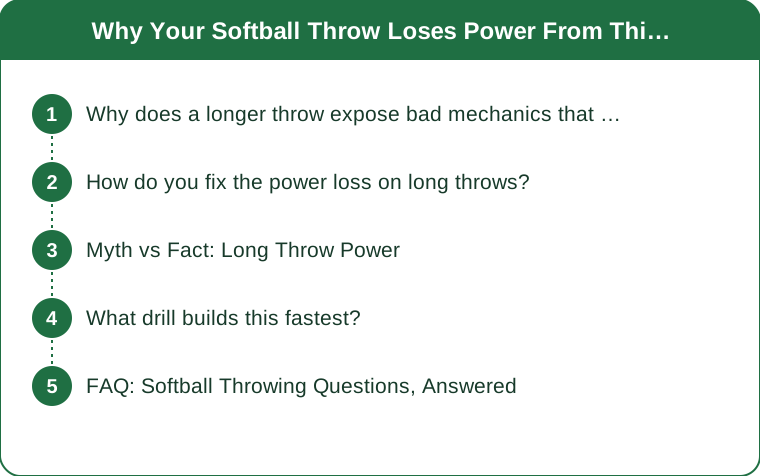
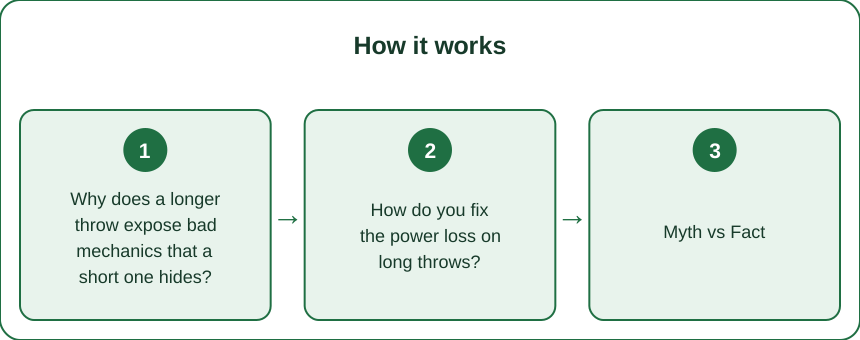
Why does a longer throw expose bad mechanics that a short one hides?
Short-distance throws need less total force, so a quick arm snap alone can cover the gap even with weak hip rotation. Longer throws require the hips to generate the power, with the arm just delivering it — and if your hip turn is small or late, there’s nothing left to make up the difference.
This is why infielders often say their arm ‘feels fine’ even on the weak long throws — the arm isn’t the problem, the engine behind it is.
How do you fix the power loss on long throws?
Start the hip rotation earlier and bigger, before the arm comes forward. A good check: your front foot and hips should be turning toward the target while your throwing arm is still cocked back — not after.
Drill it slow: field the ball, plant, and pause for a half-second with hips already turned and arm still loaded. That forces the sequence — hips first, arm second — instead of letting a rushed arm cover for lazy hips.

Myth vs Fact: Long Throw Power
Myth: A stronger arm fixes long throws. Fact: Arm strength matters, but sequencing matters more. A weaker-armed player with full hip rotation regularly outthrows a stronger arm with a rushed, hip-shortcut motion.
Myth: You should rush the release on long throws to beat the runner. Fact: Rushing is exactly what shortens hip rotation and kills power. A slightly slower, fully-rotated throw often arrives faster than a rushed, weak one because ball velocity drops so much without hip drive.
Myth: Long throw power is separate from short throw mechanics. Fact: It’s the same mechanics, just more exposed. Fixing your hip sequence on long throws cleans up subtle flaws in your short throws too.
What drill builds this fastest?
Step-behind crow hops at increasing distance, starting at 60 feet and building to your actual infield distance over a session. At each distance, exaggerate the hip turn before the arm — count ‘1’ (plant, hips turn) then ‘2’ (arm releases) out loud until the sequence feels automatic.
Do this 2-3 times a week, 15-20 throws per session, focusing on sequence over velocity for the first two weeks.
FAQ: Softball Throwing Questions, Answered
Why does my arm feel more tired after long throws even with the same number of reps?
When hip drive is missing, your arm compensates by working harder to generate the same velocity, which fatigues the shoulder and elbow faster than a throw where the hips do the heavy lifting.
Is this different for outfield throws versus infield throws?
Same principle, bigger scale. Outfield throws need even more hip and lower-body drive because the distance is longer and there’s no time to ‘muscle’ it with the arm alone.
How long before hip-sequence fixes show up in game throws?
Most players feel the difference in practice within 1-2 sessions, but it takes 3-4 weeks of drilling before the new sequence holds up automatically under game pressure.
TL;DR:
- Long throws expose weak hip rotation that short throws can mask with a quick arm alone
- Turn your hips earlier and bigger, before the arm comes forward, not after
- A slower, fully-rotated throw often beats a rushed, hip-shortcut throw
- Drill step-behind crow hops at increasing distance, sequencing hips before arm
Fix the sequence, not the arm speed, and the long throw stops dying halfway there.
Keep Reading
This article is for general informational and styling purposes only. Fit, sizing, and product availability may vary.