Why Your Softball Throws Are Strong But Not Accurate
Quick Answer: Throwing accuracy usually comes down to footwork and hip alignment toward the target, not arm strength — a strong arm with poor foot direction will consistently miss even at close range.
You can throw hard. The ball just doesn’t go where you’re aiming it. That’s almost never an arm problem.

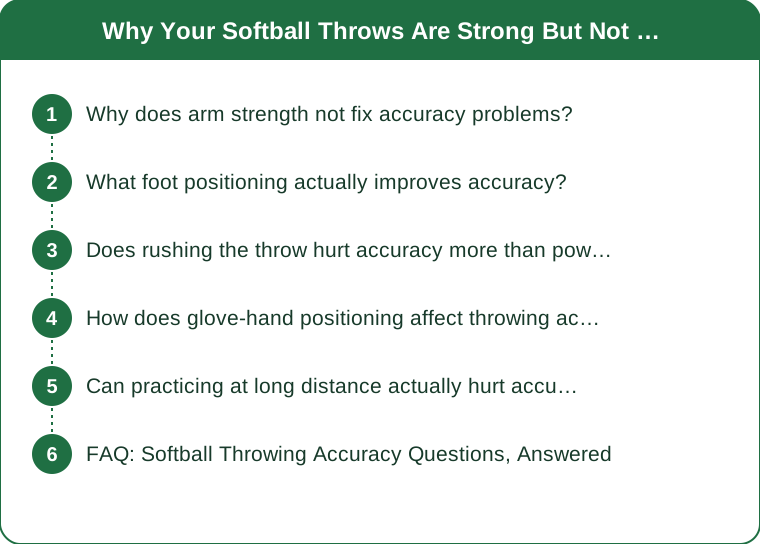
Why does arm strength not fix accuracy problems?
Arm strength determines how far and fast a ball travels, but accuracy is controlled primarily by the direction your hips, shoulders, and front foot are pointed at release. A powerful throw with feet misaligned to the target will consistently miss in a predictable direction, no matter how much velocity is behind it.
What foot positioning actually improves accuracy?
Your front (lead) foot should step directly toward the target, not off to the side or across your body, and your hips should rotate to face the target through release rather than staying open too early. A common fix drill: practice throwing with your front foot placed on a line pointed exactly at your target, exaggerating the alignment until it becomes automatic.
Does rushing the throw hurt accuracy more than power?
Yes — rushing typically causes players to release the ball before their hips and shoulders have fully rotated into alignment with the target, which is a timing problem, not a strength problem. Slowing down the transition from fielding to throwing by even a fraction of a second often improves accuracy immediately without sacrificing much speed.

How does glove-hand positioning affect throwing accuracy?
Your glove-side arm acts as a counterbalance and helps guide your shoulder rotation toward the target — if it drops or swings wildly during the throw, your shoulder alignment drifts off target with it. Keeping the glove-side elbow up and pointed roughly at the target through your throwing motion stabilizes the whole sequence.
Can practicing at long distance actually hurt accuracy training?
It can, if it’s done before short-distance mechanics are solid — long throws encourage players to compensate with arm strength rather than proper footwork and rotation, reinforcing the exact habit that causes inaccuracy. Building accuracy at 30-40 feet with correct mechanics first, then gradually extending distance, produces more reliable long-throw accuracy than starting far away.
FAQ: Softball Throwing Accuracy Questions, Answered
Is throwing accuracy something that can be drilled specifically?
Yes — target-based throwing drills (throwing at a specific spot on a fence or partner’s glove repeatedly) train accuracy directly in a way that general catch doesn’t.
Does hand size or grip affect throwing accuracy?
A proper four-seam grip does improve consistency of ball flight, but it’s a smaller factor compared to footwork and body alignment toward the target.
How quickly can accuracy improve with focused practice?
Many players see noticeable improvement within 2-3 weeks of consistent, mechanics-focused practice, since it’s largely a technique fix rather than something requiring new physical capacity.
TL;DR:
- Accuracy comes from footwork and hip alignment, not arm strength
- Step your lead foot directly at the target every throw
- Slow down the fielding-to-throw transition slightly for better rotation timing
- Build accuracy at short distance before extending to long throws
A strong arm pointed the wrong direction is still the wrong direction — fix the feet first and the accuracy usually follows fast.
Keep Reading
This article is for general informational and styling purposes only. Fit, sizing, and product availability may vary.