Why a Bat Stings More in Cold Weather and What to Do About It
Quick Answer: Cold stiffens the bat’s barrel, hardens the ball, and reduces blood flow and soft tissue compliance in your hands and forearms. All three increase the vibration that reaches you and reduce your ability to absorb it. The fixes are practical: keep bats and balls warm until use, never swing a composite bat below about 10 degrees Celsius, wear proper batting gloves, warm the hands thoroughly, and hit the sweet spot more often by shortening up.
The sting is real physics, not softness, and ignoring it can genuinely crack a composite barrel.
This blog has covered why a thrown ball tails off target, why your glove still feels stiff after weeks of breaking it in, and whether batting gloves really improve grip. Cold changes the answer to all three.
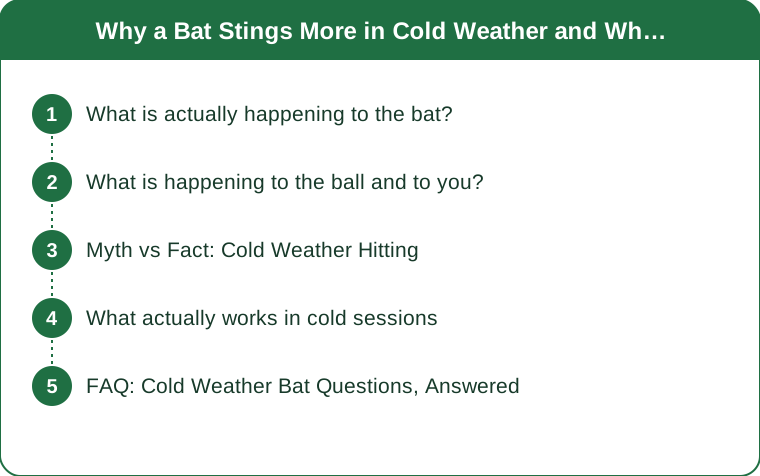
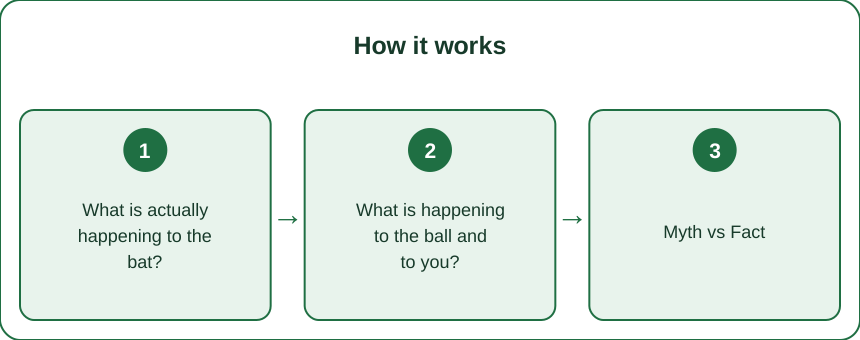
What is actually happening to the bat?
The barrel’s ability to flex — which is the whole point of a modern bat — drops in cold.
A composite or alloy barrel works by flexing on contact and returning energy to the ball. That flex is a material property and it decreases as temperature drops.
A stiffer barrel transfers more vibration into the handle. Less energy goes into elastic deformation of the barrel, so more of it travels back through your hands.
Composite bats are the most affected. The resin matrix stiffens considerably in cold, and below roughly 10 degrees Celsius most manufacturers explicitly advise against use — not for performance reasons but because cold composite is far more likely to crack.
Alloy bats handle cold better but still lose some responsiveness and transmit more sting.
The sweet spot effectively narrows. A vibrating stiffer barrel produces a stronger vibrational node response off-centre, so the margin between a clean hit and a stinging one shrinks.
And a cold bat also feels different in the hands, which subtly changes grip pressure and swing feel before contact even happens.
What is happening to the ball and to you?
The other two-thirds of the problem, and they compound.
A cold ball is harder and less compressible. A softball’s core stiffens as it cools, so it deforms less on contact and gives back a sharper impulse.
Less ball deformation means a shorter, harder contact event, and short sharp impulses produce more high-frequency vibration than longer, softer ones.
Cold balls also travel less far. Reduced coefficient of restitution plus denser air means the same swing produces a shorter hit, which frustrates hitters into swinging harder — and swinging harder off-centre stings more.
Your hands are the third factor. Cold reduces peripheral blood flow, and cold soft tissue is stiffer and less able to damp vibration.
Cold hands also grip harder. A tight grip couples your hands more rigidly to the handle and transmits considerably more vibration than a relaxed one.
And nerve sensitivity changes in cold, which is part of why the same impact registers as genuinely painful rather than merely unpleasant.

Myth vs Fact: Cold Weather Hitting
Myth: Sting means you have soft hands. Fact: Sting is vibration transfer, and it is determined by barrel stiffness, ball hardness, contact location and grip pressure. Every player stings in cold conditions off the sweet spot.
Myth: A composite bat just performs a bit worse in the cold. Fact: It can crack. Most manufacturers specify a minimum temperature around 10 degrees Celsius, and cold-weather use is a common warranty exclusion. Use an alloy bat in cold weather and keep the composite for warm days.
Myth: Warming the bat in the dugout does nothing. Fact: It genuinely helps for the first few swings, though a bat re-cools quickly. Keeping it in a bag rather than on the fence, and rotating two bats, both make a real difference.
Myth: Thicker batting gloves fix sting. Fact: They help modestly. The larger factors are grip pressure and contact location. A relaxed grip does more than any glove thickness, and thick gloves that reduce feel can make contact quality worse.
Myth: Hitting the ball harder overcomes cold. Fact: Swinging harder increases off-centre contact, which is precisely what causes sting. Shortening up and prioritising contact quality produces better results and less pain in cold conditions.
Myth: Sting is harmless. Fact: Repeated hard vibration exposure is associated with hand and forearm complaints. Persistent numbness or tingling after hitting is worth taking seriously rather than playing through.
What actually works in cold sessions
Preparation before the swing, mostly.
Keep bats and balls indoors or in a bag until use. A bat left on a fence in a cold wind is at ambient temperature within minutes; one in a bag holds warmth considerably longer.
Use an alloy bat below about 12 degrees. Save the composite for warm days and you will avoid both the sting and the crack risk.
Warm your hands properly, not just your body. Hands are the last thing to warm and the first thing to lose blood flow. Pockets, gloves between swings, and a genuine hand-focused warm-up all pay off.
Wear batting gloves and loosen your grip. Grip firmly enough to control the bat and no more; a relaxed grip is one of the largest available reductions in transmitted vibration.
Shorten up in cold weather. Choking up slightly and prioritising contact reduces off-centre hits, which is the actual source of sting.
Use warmer or lower-compression practice balls in cold cage sessions where the rules allow. A cold, hard ball off a machine is the most reliable way to make a cage session miserable.
And put a proper vibration-damping grip on your bat if sting is a recurring problem. Grip tape is cheap and the difference is not marginal.
FAQ: Cold Weather Bat Questions, Answered
Why does my bat sting so much in cold weather?
Three things at once: a colder barrel is stiffer and transmits more vibration, a colder ball is harder and produces a sharper impulse, and cold hands are stiffer and grip tighter, so they absorb less. Off-centre contact then hurts far more than it does in summer.
Can I use a composite bat in cold weather?
You should not below roughly 10 degrees Celsius. Cold stiffens the resin matrix and substantially raises the risk of cracking the barrel, and most manufacturers exclude cold-weather damage from warranty. Use an alloy bat instead.
Do batting gloves stop bat sting?
They help but they are not the main lever. Grip pressure and where you make contact matter more. A relaxed grip, a damping grip tape, and hitting closer to the sweet spot each do more than adding glove thickness.
TL;DR:
- Cold stiffens the barrel, hardens the ball, and stiffens your hands. All three increase the vibration that reaches you.
- Do not swing a composite bat below about 10°C — cracking, not just performance, is the risk. Use alloy.
- Relax your grip and choke up slightly. Grip pressure and contact location beat glove thickness every time.
- Keep bats and balls in a bag, and warm your hands specifically rather than assuming a general warm-up covers them.
Sting in October is physics doing its job. Change the equipment and the grip, not your tolerance for pain.
Keep Reading
This article is for general informational and styling purposes only. Fit, sizing, and product availability may vary.