Why Does a Thrown Ball Tail Off Target Even When Your Throwing Mechanics Look Correct?
Quick Answer: A ball that tails off target despite good arm mechanics most often comes down to hand and finger position at release, specifically inconsistent seam grip or a slightly off-center release point, rather than the larger arm motion — small release-point inconsistencies are much harder to notice than obvious mechanical flaws, which is why they persist even in players with otherwise clean throwing form.

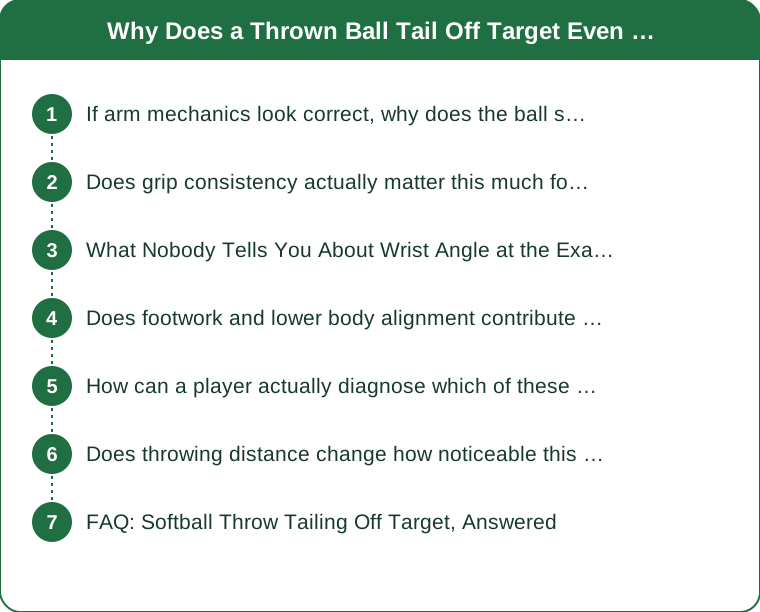
If arm mechanics look correct, why does the ball still miss the target?
The final release point — where exactly the ball leaves the fingers and hand — is the last and most precision-sensitive part of a throw, and even a throwing motion that looks mechanically sound through the wind-up and arm path can still produce an inconsistent release point due to grip variation or subtle wrist angle differences, which affects the ball’s initial direction and spin independent of how correct the larger arm motion appears.
Does grip consistency actually matter this much for direction, not just spin?
Yes — an inconsistent finger position across the ball’s seams changes both spin and the ball’s initial exit angle from the hand, and a grip that shifts slightly from throw to throw (even without the thrower consciously noticing) introduces a variable the thrower isn’t actively controlling, which shows up as inconsistent tailing rather than a single, correctable directional bias.
What Nobody Tells You About Wrist Angle at the Exact Moment of Release
A wrist that’s even slightly pronated or supinated relative to a neutral position at release imparts unintended side-spin on the ball, causing it to curve or tail in a specific direction during flight — this wrist angle issue is often invisible to the thrower and even to a casual outside observer, since it happens in a fraction of a second at the very end of an otherwise normal-looking arm motion, which is exactly why it goes undiagnosed for so long.

Does footwork and lower body alignment contribute to this even if the arm looks fine?
Yes — if the front foot and hips aren’t aligned toward the actual target, the arm can still execute a mechanically clean throwing motion while the entire throw is aimed slightly off-line from the start, meaning the arm’s mechanics can look perfect on video while the whole kinetic chain was aimed in a slightly wrong direction before the arm even entered its throwing motion.
How can a player actually diagnose which of these factors is causing their own tailing issue?
Slow-motion video specifically focused on the hand and release point, not just the overall arm swing, is the most direct way to identify grip and wrist angle inconsistency — comparing several throws side by side at the exact release frame often reveals a visibly different finger or wrist position between throws that land on target versus throws that tail off, which is a more targeted diagnostic than reviewing the full arm motion alone.
Does throwing distance change how noticeable this release inconsistency becomes?
Yes — the same small release-point inconsistency creates proportionally more lateral deviation over a longer throw distance, which is why tailing problems often become more apparent and frustrating on longer outfield throws than on short infield throws, even though the underlying release inconsistency is present at every distance.
FAQ: Softball Throw Tailing Off Target, Answered
Can this be fixed through drills, or does it require completely relearning the throw?
Most release-point inconsistencies improve through targeted repetition drills (like wall throws focusing purely on release feel) rather than requiring a full mechanical overhaul of the throwing motion.
Does grip strength or hand size affect how consistent a release can be?
Smaller hands or lower grip strength can make consistent seam grip slightly more challenging, though proper grip technique and specific hand-strengthening work can meaningfully close this gap over time.
Should a coach focus on the release point before addressing the bigger arm motion?
If the bigger arm motion is already mechanically sound, yes — addressing the release point specifically is usually more productive than continuing to drill an arm motion that isn’t actually the source of the problem.
TL;DR:
- Tailing throws usually trace to release point issues, not the larger arm motion
- Inconsistent seam grip and wrist angle at release both introduce unintended spin and direction
- Footwork and hip alignment can aim an otherwise mechanically clean throw off-target from the start
- Slow-motion video focused specifically on the release frame is the most useful diagnostic tool
Good-looking mechanics through the wind-up don’t guarantee accuracy — the last fraction of a second at release is where most tailing problems actually live.
Keep Reading
This article is for general informational and styling purposes only. Fit, sizing, and product availability may vary.