Why Your Softball Glove Still Feels Stiff After Weeks of 'Breaking It In'
Quick Answer: Stiffness that persists after weeks of playing catch usually means the leather’s fibers haven’t been mechanically worked in the pocket area specifically, not just generally used — playing catch alone flexes the glove unevenly, while a proper break-in needs repeated, focused pressure exactly where the ball lands.
You’ve played catch consistently and even applied conditioner as directed. The glove still snaps back to its original shape instead of holding a pocket. That’s less about time invested and more about where that effort was actually applied on the glove.

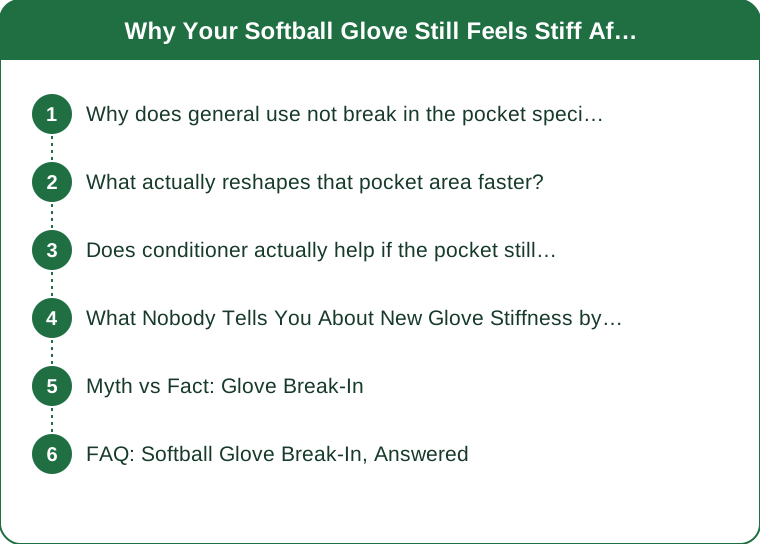
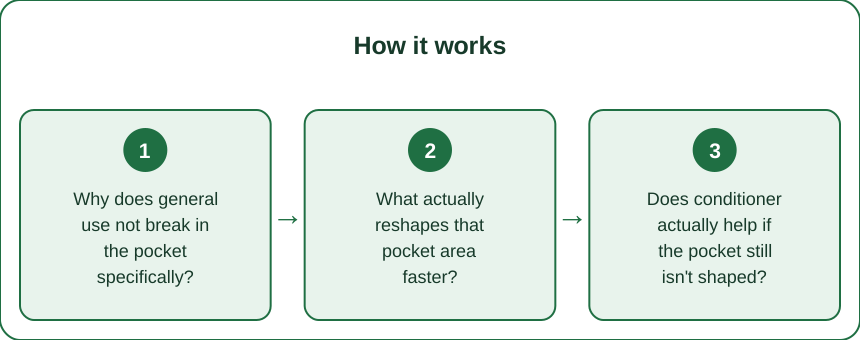
Why does general use not break in the pocket specifically?
Playing catch flexes the entire glove somewhat evenly — the fingers, the heel, the web — but the deep pocket curve where a caught ball actually settles needs concentrated, repeated pressure in that exact spot to reshape the leather fibers there. General catch play distributes wear broadly rather than focusing it, which is why a glove can feel ‘used’ overall while the pocket area specifically stays stubbornly stiff.
What actually reshapes that pocket area faster?
Placing a ball (or a glove mallet) directly in the pocket, folding the glove closed around it, and securing it tightly with a strap or rubber bands overnight repeatedly over several days applies sustained, focused pressure exactly where catch play alone doesn’t concentrate enough force. This targeted compression is what most ‘I played catch for weeks and it’s still stiff’ routines are missing.
Does conditioner actually help if the pocket still isn’t shaped?
Conditioner softens leather fibers and makes them more receptive to reshaping, but it doesn’t reshape anything by itself — applying conditioner without the sustained ball-and-strap pressure step softens the material without giving it a reason to hold a new shape. The two steps work together: condition to soften, then compress to reshape, in that order.

What Nobody Tells You About New Glove Stiffness by Leather Grade
Here’s a detail rarely explained at purchase: higher-grade, thicker premium leather gloves are often intentionally stiffer out of the box and take meaningfully longer to break in than budget gloves with thinner leather — this isn’t a flaw, it’s a durability tradeoff, since that same dense leather holds its shape and lasts years longer once properly broken in. If you bought a premium glove expecting a budget glove’s quick break-in timeline, the extended stiffness is expected, not a defect.
Myth vs Fact: Glove Break-In
Myth: Playing catch alone will eventually break in any glove. Fact: General catch play under-focuses pressure exactly where the pocket needs it most.
Myth: More conditioner always speeds up break-in. Fact: Conditioner softens leather but doesn’t reshape it — the ball-and-strap compression step does that part.
Myth: A stiff glove after a month means something’s wrong with it. Fact: Premium leather gloves are often intentionally stiffer and take longer, by design, than budget gloves.
FAQ: Softball Glove Break-In, Answered
How long should the ball-and-strap method run each time?
Overnight sessions repeated over 1-2 weeks work well for most gloves — a single overnight rarely fully reshapes the pocket.
Is a glove mallet actually necessary, or does a ball work fine?
A ball works fine for most players; a mallet applies more even pressure and is worth it mainly for very stiff premium leather gloves.
Should I condition before or after the ball-and-strap compression?
Condition first to soften the leather, then apply the ball-and-strap compression while the leather is still receptive to reshaping.
TL;DR:
- Playing catch alone under-focuses pressure exactly where the pocket needs reshaping
- Ball-and-strap overnight compression targets that spot specifically — condition first, then compress
- Premium thicker leather gloves are intentionally stiffer and take longer, not defective
- Repeat the compression step over 1-2 weeks rather than expecting one overnight session to finish the job
Tonight, skip another round of plain catch and instead strap a ball into the pocket overnight — that’s the step most stalled break-ins are actually missing.
Keep Reading
This article is for general informational and styling purposes only. Fit, sizing, and product availability may vary.