Why Your Throwing Arm Feels Worse the Day After a Light Practice
Quick Answer: Arm soreness tracks intensity variation and deceleration load, not total throw count. A casual practice full of long, lazy, half-effort throws from odd positions loads the deceleration muscles harder than a structured game does. Add a cold arm and no warm-up because it was only a light session, and the next day is worse. The fix is a real warm-up regardless of intent, throwing on a progressive distance ladder, and treating light days as structured rather than casual.
You threw a third as much as a game.
And this is the sorest your arm has been.
Count was never the variable.
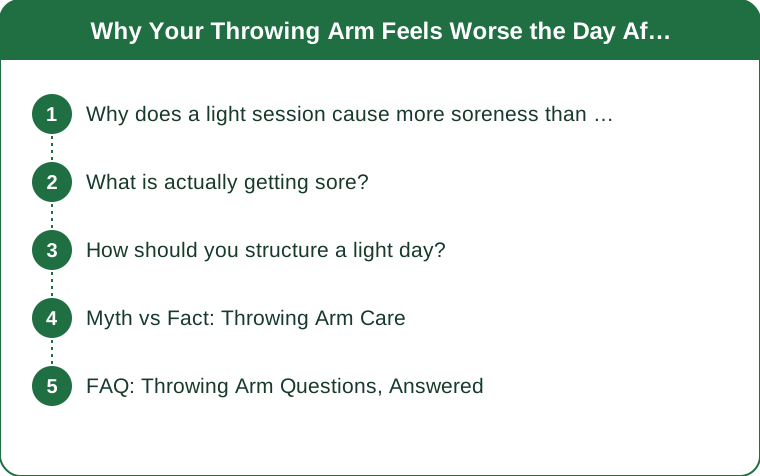
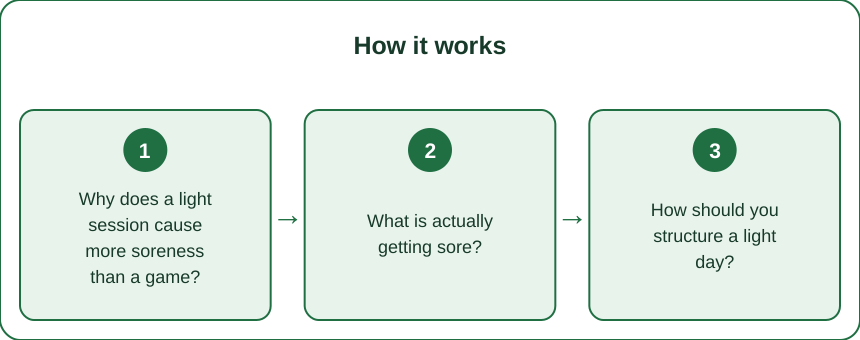
Why does a light session cause more soreness than a game?
Because the throws themselves are different in ways that matter.
Casual long toss is deceptively demanding. Long, arcing throws at 70% effort require your shoulder to decelerate the arm over a long range with poor mechanics, repeatedly. Deceleration — the eccentric work of the rotator cuff and posterior shoulder — is where the damage accumulates.
Half-effort throws often have worse mechanics than full-effort ones. At full intensity your body sequences properly: legs, hips, trunk, then arm. At 60% people arm it, cutting the lower body out and putting the whole load on the shoulder.
Odd positions multiply the problem. Standing flat-footed, throwing from a knee, tossing sideways during drills — all remove the kinetic chain and leave the shoulder to do the work alone.
A light session usually gets a light warm-up. Because it does not feel serious, the arm never fully warms, and the first twenty throws happen on cold tissue.
And light sessions have no structure. A game has innings, rest between them and a defined role. A casual practice can involve fifty unstructured throws across an hour with no pattern at all.
Which reverses the usual assumption: the session you did not take seriously is often the one your arm takes hardest.
What is actually getting sore?
Usually the back of the shoulder, and for a specific reason.
The posterior rotator cuff does the braking. After ball release, the arm has to be slowed from very high rotational speed. That is eccentric work done by the infraspinatus, teres minor and posterior deltoid, and it is where most throwing soreness lives.
Eccentric load causes more muscle damage than concentric. Slowing something down produces more microtrauma than speeding it up. This is a general principle, and throwing is one of the most extreme examples in sport.
Delayed onset is normal and expected. Soreness peaking 24 to 48 hours later is standard eccentric damage. It is not, by itself, a sign of injury.
Front-of-shoulder pain is different. Anterior pain, particularly sharp pain during the cocking phase, is worth attention rather than management. So is pain on the inside of the elbow.
Forearm and elbow soreness usually signals mechanics. When the lower body is not contributing, the elbow absorbs load it is not designed for. Persistent inner-elbow pain is the one to stop and address.
The distinction that matters: diffuse posterior soreness that eases with movement is normal training response. Sharp, localised, or pain that gets worse as you throw is a stop signal.
This is general information, not medical advice. Persistent or sharp throwing pain warrants assessment by a qualified professional.

How should you structure a light day?
Six rules that make a light day genuinely light.
Warm up the same way regardless of session intent. 5 to 10 minutes raising body temperature, then band work for the rotator cuff, then arm circles and dynamic movement. Cold tissue is less compliant and takes eccentric load badly.
Use a progressive distance ladder. Start at 15 feet, build outward in stages, and — the part everyone skips — come back down before you stop. Finishing at maximum distance leaves the arm loaded; walking the distance back in unloads it.
Cap the long toss. Long toss has real value and is easy to overdose casually. 10 to 15 throws at your longest distance is plenty.
Throw with your legs even at low effort. Take a crow hop, use your lower body, keep the sequence intact. Lazy throws are not lighter for your shoulder; they simply shift the work to it.
Count your throws, even casually. Most people underestimate a casual session by a wide margin. A rough count is enough to notice a hundred-throw afternoon that felt like nothing.
Finish with the arm feeling loose, not empty. The point of a light day is recovery and feel. If you finish fatigued, it was not a light day.
Seasonal note: cooler evenings arrive before the season ends, and the warm-up that was adequate in July is not adequate for a 6pm practice in late September. Cold tissue plus long toss is the most common source of early-autumn arm trouble.
Myth vs Fact: Throwing Arm Care
Myth: soreness means you threw too much. Fact: it usually means you threw with poor mechanics, without a warm-up, or with too much long toss. Count is a weak predictor.
Myth: icing after every session is necessary. Fact: current thinking favours movement, blood flow and gentle activity over routine icing for normal soreness. Ice has a place for acute injury, not as a default.
Myth: throwing through soreness builds arm strength. Fact: throwing through pain accumulates damage. Normal diffuse soreness that eases as you warm up is usually fine; sharp or worsening pain is not.
Myth: light throwing does not need a warm-up. Fact: this is the single most common cause of the problem this article describes. The tissue does not know your intentions.
Myth: arm care means shoulder exercises. Fact: a large share of shoulder and elbow load comes from a weak or unused lower body and trunk. Hip and core strength are arm care.
Myth: long toss is always good for the arm. Fact: structured long toss with a return ladder is valuable. Unstructured maximum-distance throwing until you get bored is one of the more reliable ways to hurt yourself.
Myth: rest is the only recovery. Fact: light movement, band work and sleep do more than complete inactivity. Total rest for several days can leave the arm feeling worse on return.
FAQ: Throwing Arm Questions, Answered
How sore is too sore?
Diffuse soreness in the back of the shoulder that eases with warm-up is normal. Sharp pain, front-of-shoulder pain, inner-elbow pain or soreness that worsens as you throw means stop.
How long should soreness last?
24 to 48 hours for normal eccentric response. Beyond three days suggests the session was too much or the mechanics need attention.
Should I ice my arm after throwing?
For normal soreness, gentle movement and blood flow are generally preferred. Ice is more appropriate for acute injury.
How much long toss is reasonable?
10 to 15 throws at your longest distance, then work back down. The return ladder is the part people skip and the part that matters.
Why does my elbow hurt more than my shoulder?
Usually mechanics — the lower body is not contributing, so the elbow absorbs load. Persistent inner-elbow pain warrants professional assessment.
Do bands actually help?
Yes. Light band work for the rotator cuff, before throwing to prepare and after to maintain balance, is the most consistently recommended piece of arm care there is.
Can I throw on back-to-back days?
Yes, with intensity varied deliberately — a high day followed by a genuinely structured low day. Two moderate unstructured days in a row is the pattern that causes trouble.
This is general information and not a substitute for assessment by a qualified medical or athletic professional.
TL;DR:
- Arm soreness tracks deceleration load and mechanics, not throw count.
- Half-effort throws often have worse mechanics than full ones — the shoulder does work the legs should.
- Light sessions get light warm-ups, and cold tissue takes eccentric load badly.
- Use a progressive distance ladder and come back down before you finish.
- Diffuse posterior soreness for 24 to 48 hours is normal; sharp, front-of-shoulder or inner-elbow pain is not.
At your next casual session, warm up as if it were a game and finish by throwing your way back in from long distance. That is most of the fix.
Keep Reading
This article is for general informational and styling purposes only. Fit, sizing, and product availability may vary.