Why Your Timing Goes First When the Light Changes in Late Season
Quick Answer: As light drops, your eyes shift toward rod-dominated vision, which is better in low light but far worse at resolving detail and tracking fast movement. Pitch recognition depends on picking up spin and release point in the first fraction of a second, and that is exactly what degrades. The result is late swings and poor pitch selection while your swing mechanics remain completely unchanged.
You hit well in the first three innings. By the sixth, the same pitcher looks quicker and you are fouling off pitches you were driving.
Nothing about your swing changed. What changed was how much information your eyes were delivering.
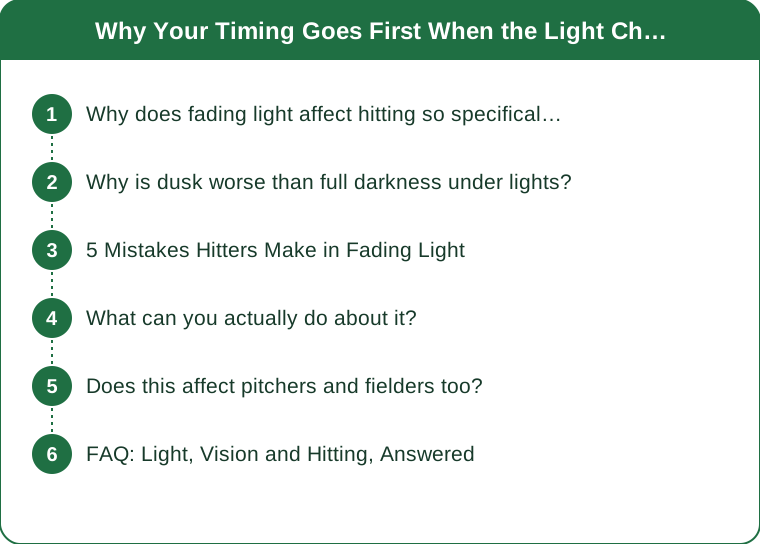
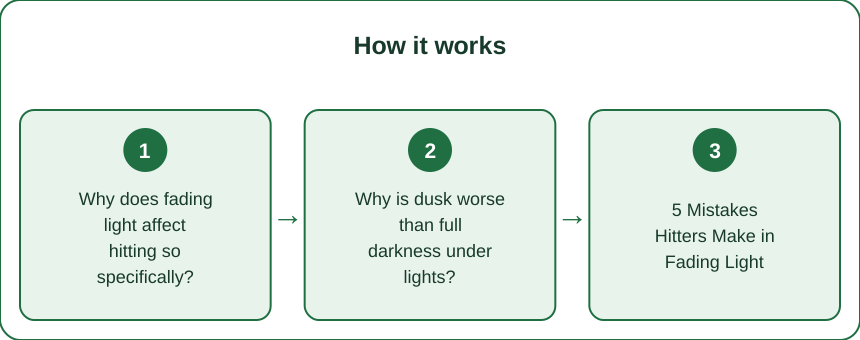
Why does fading light affect hitting so specifically?
Because hitting is fundamentally a recognition task with a very short window.
A pitch gives you a fraction of a second between release and commitment. In that window you are reading release point, spin direction, and early trajectory. Everything downstream — timing, swing decision, contact quality — depends on the information gathered in that instant.
As ambient light falls, your visual system transitions from cone-dominated vision, which handles fine detail and colour, toward rod-dominated vision, which is far more sensitive in low light but has much poorer acuity and slower temporal resolution.
Practically, this means spin becomes harder to read before anything else does. The seams blur. A rise and a change look more alike. And you make your swing decision on worse information, slightly later.
The reason it feels like the pitcher got faster is that your recognition happened later, leaving less time to react. Perceived velocity is largely a function of how early you picked the ball up, which is why the same pitcher genuinely does look quicker at 7pm than at 5pm.
Why is dusk worse than full darkness under lights?
This surprises people, and it is consistent.
A fully lit field at night is a stable, uniform visual environment. Your eyes adapt to it, the background is consistent, and after an inning or two you are working with reliable if imperfect information.
Dusk is the transition, and transitions are where the visual system struggles most. Light is falling continuously, so your adaptation is always slightly behind. The sky is still brighter than the ground, creating a high-contrast background that changes as the ball travels. And field lights coming on partway through create mixed lighting with multiple shadows.
The worst period is roughly the thirty minutes around sunset, and it maps closely onto when late-season games reach their middle innings.
There is a second factor: shadows moving across the infield. In late afternoon, a ball can travel from sunlight into shade during its flight. Your eyes cannot adapt in that timeframe, so the ball effectively dims mid-flight. Fielders experience this even more acutely than hitters, which is why routine fly balls become adventures at exactly this time of day.
5 Mistakes Hitters Make in Fading Light
1. Swinging harder to compensate. The natural response to feeling late is to try to catch up with more effort. Effort adds nothing to bat speed at the point it matters and costs a great deal in control and in the ability to adjust mid-swing. The correct adjustment is to start earlier, not to swing harder.
2. Not adjusting the load and stride timing. If recognition is happening later, the whole sequence needs to begin earlier. Starting the load a fraction sooner buys back most of the lost time. This is a conscious adjustment that has to be made deliberately — it does not happen on its own.
3. Expanding the zone. Poorer pitch recognition means more uncertainty, and uncertainty makes hitters swing at more. The discipline that matters most is exactly the discipline that degrades. Consciously tightening the zone in the late innings is counterintuitive and correct.
4. Keeping sunglasses on too long. Common in games that start in bright sun. Any tint costs light, and in fading conditions that cost is significant. They should come off well before you think they need to — typically at the point the sun is off the field entirely.
5. Not looking at the release point deliberately. In good light you can be sloppy about where your eyes are and still pick the ball up. In poor light, a consistent visual routine — a soft focus on the pitcher, then a hard focus on the release window — meaningfully improves what you gather. Hitters who have a routine hold up much better in bad light than those who rely on general awareness.
And the mistake underneath all five: assuming it is a mechanical problem. Hitters spend late-season innings adjusting their hands and their stance when nothing mechanical has changed at all.
What can you actually do about it?
Some of this is adaptable and some is worth simply planning around.
Start your timing earlier in the late innings. The single most effective adjustment. A slightly earlier load, and being ready sooner, buys back the time that late recognition costs.
Shorten up rather than swinging bigger. A slightly shorter, more direct swing gives you more time to decide and more margin on contact. This is the standard two-strike approach and it is worth adopting earlier than two strikes when the light is bad.
Track the pitcher’s release from the on-deck circle. Live reps at the actual light level are far more useful than anything else available. Hitters who use the on-deck time to watch the ball out of the hand rather than to take practice swings adapt faster.
Take your warm-up swings looking at something, not at nothing. Visual engagement warms up the recognition system, and a hitter who has been standing in the dugout for twenty minutes arrives with cold eyes as well as cold hands.
Let your eyes adapt before you hit. Full dark adaptation takes twenty minutes or more, and a phone screen in the dugout resets a good deal of it. This is a small thing with a measurable effect and it costs nothing.
For fielders: sunglasses off, position slightly deeper, and expect to lose balls at the transition. Charging a ball you cannot see clearly is how injuries happen.
Does this affect pitchers and fielders too?
It affects everyone, but asymmetrically, and the asymmetry usually favours the pitcher.
Pitchers gain. Their task — repeating a known motion toward a large stationary target — is far less visually demanding than the hitter’s. Fading light degrades the batter’s job substantially and the pitcher’s barely at all. This is why scoring drops in the late innings of dusk games well beyond what fatigue explains.
Infielders lose most on hard-hit balls, where reaction time is short and the ball may cross a shadow line. Positioning a step deeper gives back some of the reaction time.
Outfielders lose most on high fly balls, which travel against a bright sky and then descend against a dark background. The classic late-afternoon misplay is a ball that is easy to see going up and impossible to see coming down.
Catchers are affected in a way nobody discusses — pitch framing and blocking both depend on early recognition, and passed balls increase in poor light.
The tactical implication for a team is straightforward: if you know the light will fade, the innings before it does are worth more. Aggressive baserunning and hitting early rather than working counts is a reasonable adjustment, because runs get harder to score as the game goes on. Teams that understand this play the first four innings differently.
FAQ: Light, Vision and Hitting, Answered
Do amber or yellow lenses actually help in low light?
They increase contrast, which some hitters genuinely find useful in flat or overcast conditions. But any lens blocks some light, and in genuinely fading conditions that trade usually goes the wrong way. Most players do better removing eyewear entirely once the sun is off the field.
Is this the same thing as losing a ball in the sun?
No, they are different problems with opposite causes. Losing a ball in the sun is glare — too much light overwhelming the visual system in one part of the field. Fading-light difficulty is insufficient light degrading acuity everywhere. Sunglasses help the first and hurt the second, which is why the timing of taking them off matters.
Can vision training improve this?
Some. Training that focuses on early pitch recognition — reading spin, identifying pitch type from release — does appear to help hitters, and those gains carry into poor light where recognition matters most. Generic eye exercises unrelated to the specific task show much weaker results. If you train it, train it with a pitch.
TL;DR:
- Fading light shifts your vision toward rod dominance, which reads spin and fast movement much worse — recognition happens later.
- The pitcher appears faster because you picked the ball up later, not because velocity changed.
- Dusk is worse than full darkness under lights, because a changing environment prevents adaptation.
- Start your timing earlier and shorten your swing rather than swinging harder; tighten the zone rather than expanding it.
- The effect is asymmetric — pitchers barely lose anything, so runs get harder as the game goes on.
The practical value of understanding this is that it stops you fixing something that is not broken. A hitter who goes hitless in the last three innings of a dusk game and spends the following week rebuilding their swing has diagnosed a lighting problem as a mechanical one — and will arrive at the next game with a worse swing and the same light.
Keep Reading
This article is for general informational and styling purposes only. Fit, sizing, and product availability may vary.